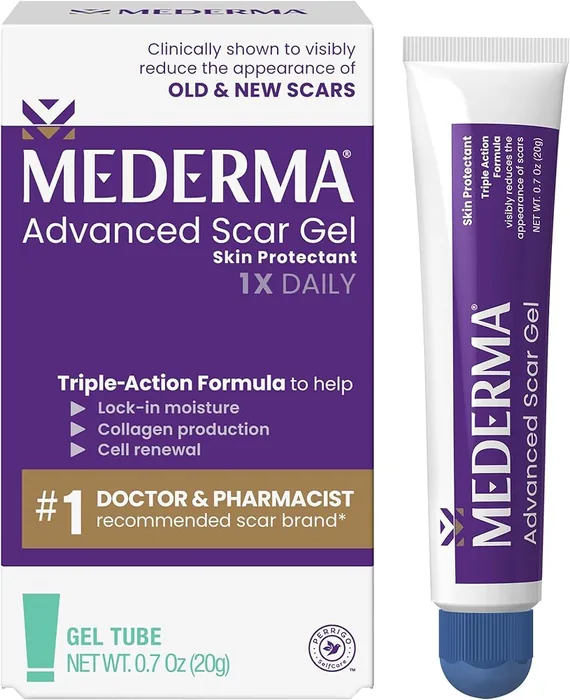
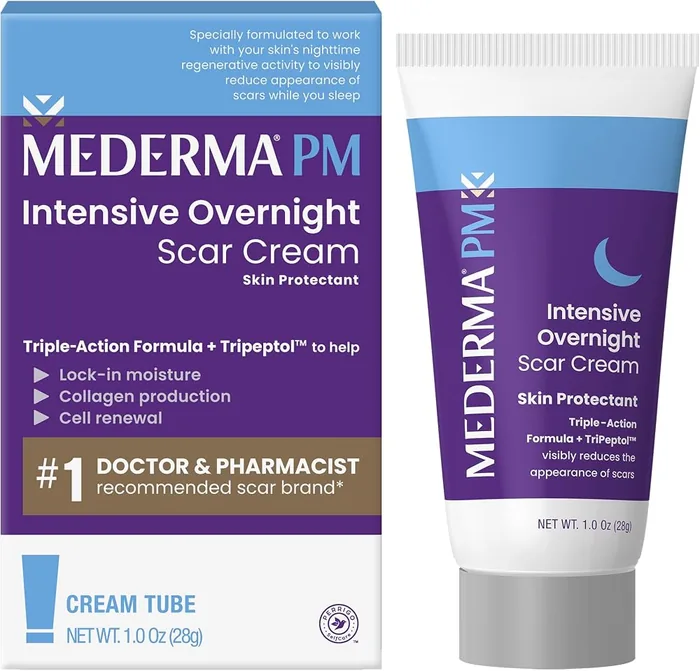
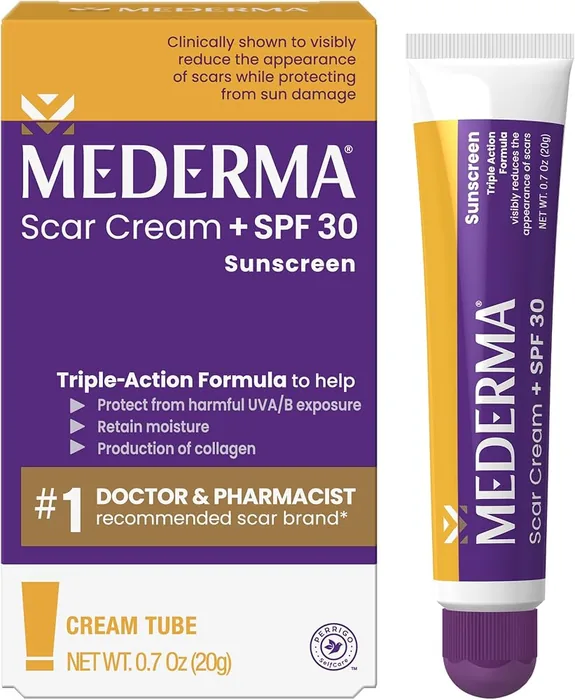
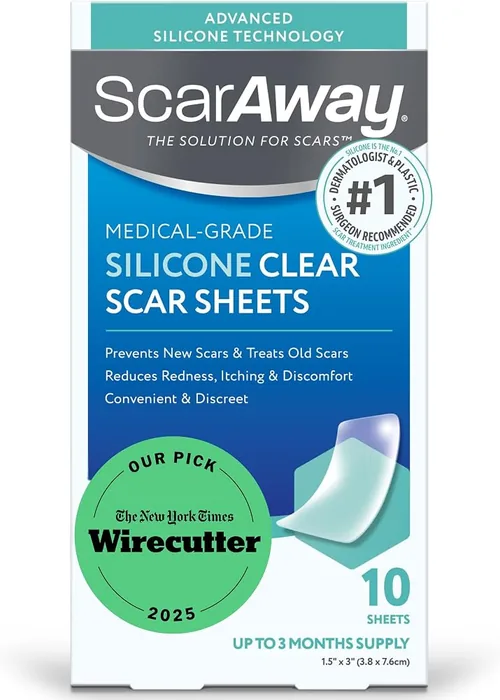
Mederma vs ScarAway at a glance
If you want the short answer, ScarAway often makes more sense when you want silicone-based scar care, especially for newer, raised, or post-surgical scars. Mederma can still make sense if you want a simple gel format and prefer a once-daily routine, but the better choice depends less on the brand name and more on the type of scar, the format you will actually use consistently, and how realistic your expectations are.
Scar products do not erase scars. The useful ones may help improve the appearance of texture, color, softness, and overall visibility over time. That is very different from complete removal.
The main decision factors here are:
- scar type
- age of scar
- ingredient profile
- gel vs sheet format
- consistency of use
- budget over a full course of treatment
Quick verdict for different buyers
- Choose Mederma if you want a simple gel, dislike adhesive sheets, and are mainly looking for a low-fuss option for a smaller scar.
- Choose ScarAway if you want the more evidence-aligned over-the-counter scar-care approach, especially if the product uses silicone gel or silicone sheets.
- Choose neither without dermatology input if you have a severe raised scar, suspected keloid, painful scar, scar contracture, or deep pitted acne scarring.
What this comparison is based on
This comparison is based on:
- official product positioning and ingredient logic
- published evidence around silicone and scar care
- real-world usability, including texture, adherence, and convenience
- realistic expectation-setting rather than dramatic before-and-after marketing
How scar treatments actually work and what they cannot do
The first thing to get clear is the job of an over-the-counter scar treatment. It is not to remove a scar completely. It is to help a scar heal or mature in a way that may leave it less raised, less stiff, less noticeable, or more even in color and texture.
That distinction matters because many disappointing purchases happen when a topical product is expected to fix something it cannot fully fix.
The scar types most relevant here are surgical scars, injury scars, minor burn scars, acne marks, raised scars, and older flat scars.
Timeline also matters. Scar care is usually a weeks-to-months game, not a quick fix. And when people search for terms like scar away before and after, it is worth remembering that scar photos can look more dramatic than the real-world change.
Which scars usually respond best to OTC treatment?
In general, newer scars and raised scars tend to be better candidates for over-the-counter scar care than deep, pitted acne scars or severe keloid-prone scarring.
A newer scar is still going through remodeling. That gives topical care more room to support a better-looking final result. Older scars can still improve, but usually more subtly.
Why silicone gets so much attention
Silicone gets attention because it is one of the better-established over-the-counter approaches in scar management. It is often used in gels and sheets for scars that are healing, raised, or prone to becoming more visible over time.
That does not mean every silicone product is magic. It means silicone has a stronger evidence-aware case than many plant- or botanical-led scar formulas when the goal is to improve the appearance of certain scars.
When before-and-after photos can mislead
Before-and-after photos can be useful, but they are not perfect evidence. A scar can look better in a photo because of different lighting, reduced swelling over time, angle changes, better hydration, makeup or skin prep, or the scar simply maturing naturally.
That is why dramatic transformation claims should be treated carefully.
Ingredients and formula differences: Mederma vs ScarAway
The biggest practical difference between Mederma and ScarAway is usually non-silicone gel versus silicone-based treatment, though exact formulas vary by product.
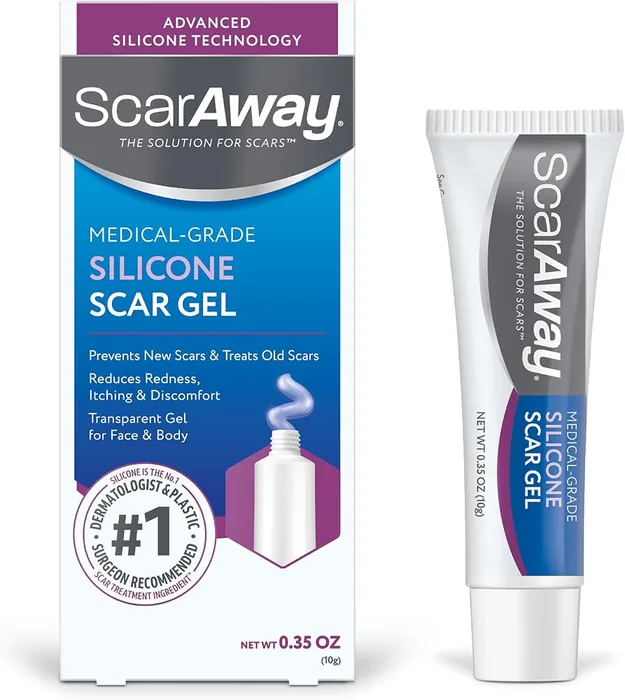
Mederma is commonly associated with Cepalin, an onion extract-based formula, while ScarAway is more strongly associated with silicone gels and silicone sheets.
From a buyer perspective, this affects not just ingredient logic but also finish, drying time, layering, and where the product is easiest to use.
| Brand | Core formula logic | Common format strength | Best practical fit |
|---|---|---|---|
| Mederma | Non-silicone scar gel, often centered on onion extract | Simple topical gel | Buyers who want a straightforward gel routine |
| ScarAway | Silicone-led scar care | Silicone gel and silicone sheets | Buyers focused on raised, surgical, or newer scars |
Mederma: what the formula is trying to do
Mederma is positioned as an easy scar gel option for old and new scars. In its well-known formulas, the logic is less about creating a silicone barrier and more about using its signature onion extract approach in a simple, easy-to-apply gel.
That may appeal to buyers who want once-daily use, do not want sheets on the skin, or prefer a product that feels more like a standard topical gel.
The trade-off is that, on paper, it does not look as evidence-aligned as silicone-based scar care for raised or post-surgical scars.
ScarAway: what the formula is trying to do
ScarAway is more tightly associated with medical-style silicone scar care, especially silicone sheets and silicone gel.
That matters because silicone is often the more discussed option for surgical scars, C-section scars, raised scars, and scars that benefit from consistent occlusive support.
If your main question is which brand has the stronger scar-care angle on paper, ScarAway usually has the advantage when silicone is the main active.
Silicone gel vs silicone sheets vs non-silicone gel
Each format has real trade-offs.
| Format | Pros | Cons | Best for |
|---|---|---|---|
| Silicone gel | Less bulky than sheets, easier on curved areas, often more discreet | Needs regular application and drying time | Facial scars, mobile areas, people who dislike sheets |
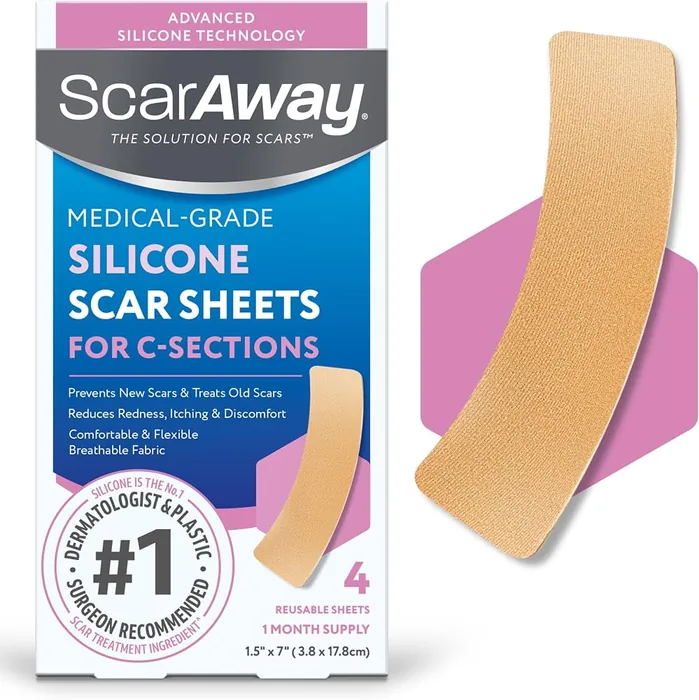
| Silicone sheets | Strong practical option for linear scars, consistent coverage, less daily guesswork once applied | Can feel visible, may loosen, may irritate adhesive-sensitive skin | Surgical scars, C-section scars, flatter body areas |
| Non-silicone gel | Easy routine, lightweight, familiar texture | Weaker evidence case compared with silicone for some scar types | Buyers who prioritize convenience over the strongest evidence-aligned format |
Which formula looks stronger on paper?
ScarAway usually looks stronger on paper when comparing silicone gel or silicone sheets against a non-silicone onion extract gel.
That does not automatically make Mederma useless. It means ScarAway often has the more evidence-aligned over-the-counter scar-care angle, while Mederma may still appeal if you want simplicity, dislike sheets, or are more likely to stick with a basic gel.
Performance by scar type: old scars, new scars, surgical scars, and acne marks
The real question is not which brand is best. It is which one makes more sense for your scar.
Mederma vs ScarAway for new scars
For new scars, there is usually a better chance of visible improvement because the scar is still maturing. Once the wound is fully closed and you are following product directions, this is often the point where scar care can be most useful.
For newer scars, ScarAway often has the edge, especially if the scar is raised or surgical and silicone is a good fit.
Mederma vs ScarAway for old scars
A lot of buyers ask: does Mederma really work on old scars or does ScarAway work on old scars?
The realistic answer is that old scars can improve, but usually modestly. You may see some softening, smoothing, or reduction in visible redness or unevenness. You should not expect an older scar to disappear.
If the old scar is raised, ScarAway still tends to make more sense. If the scar is older, flat, and you simply want a low-effort gel, Mederma may feel easier to commit to, even if the likely result is subtle.
Which is better for surgical and C-section scars?
For surgical and C-section scars, ScarAway usually makes more sense, especially in sheet form for longer linear scars.
Silicone sheets can be a practical match for healed incision lines, larger flat areas, and scars where you want consistent contact over time.
A gel may be easier if the area is curved, mobile, or hard to keep covered with a sheet.
Which is better for acne scars or facial scars?
This is where expectation-setting matters most. Neither Mederma nor ScarAway is likely to do much for deep atrophic acne scars, meaning pitted or indented scars.
They may be more useful for superficial marks, post-inflammatory discoloration, a newer facial scar from injury or procedure, or a slightly raised scar.
For true textural acne scarring, over-the-counter scar gels have a ceiling.
Real-world trade-offs: ease of use, irritation risk, value, and user feedback
Ingredients matter, but buyers live with the product day to day. That means drying time, stickiness, visibility, comfort, and routine burden all matter too.
What consistency really looks like
Scar treatment often comes down to one unglamorous factor: can you keep using it for long enough?
A product with better ingredient logic does not help much if you stop after two weeks because it is annoying to wear. In real life, sheets can be effective but feel inconvenient, gels can be easier but require consistent routine follow-through, facial use often favors lighter and less visible formats, and body scars may be easier to treat with sheets if clothing does not interfere.
Side effects and skin tolerance
Possible issues can include adhesive sensitivity with sheets, irritation from additives or fragrance where relevant, discomfort on recently healed or reactive skin, and sheet slippage in high-movement areas.
Sensitive skin users may prefer to patch test where reasonable and avoid pushing scar products onto skin that is not fully healed.
Price and value over a full course of use
Sticker price is only part of the story. You also need to think about how long a tube lasts, how many sheets are needed, whether the scar is small or large, and whether you are treating one area or multiple.
| Option | Value strengths | Value limitations |
|---|---|---|
| Mederma gel | Often simpler for small-scar use and straightforward routines | May feel expensive if results are subtle and long-term use is needed |
| ScarAway gel | Silicone format may justify cost better for some scar types | Can still add up over months of use |
| ScarAway sheets | Good practical value for surgical scars if sheets stay in place well | Cost can rise for large areas or long treatment windows |
What reviews and forums can tell you, and what they cannot
When people search scaraway vs mederma reddit, they are usually looking for practical experience, not clinical evidence.
Reviews and forums can help identify patterns like whether sheets stay on well, whether a gel feels sticky, whether the product is easy to use under clothing, and whether users felt the change was subtle or worthwhile.
What they cannot do is prove that one product will work for your scar.
Final verdict: should you buy Mederma or ScarAway?
If you want the clearest decision summary, it is this:
- Buy ScarAway if your priority is silicone-based scar care, especially for newer, raised, surgical, or C-section scars.
- Buy Mederma if you want a simpler gel routine and are more likely to stick with that than with sheets or silicone layering.
- Buy neither as a miracle fix for deep acne scarring, severe keloids, or scars causing significant cosmetic or physical distress.
ScarAway is usually the stronger choice on paper. Mederma is often the easier or more familiar choice in practice. The better buy depends on whether you want the more evidence-aligned format or the routine you are actually willing to maintain.
Best for / skip if summary
| Product | Best for | Skip if |
|---|---|---|
| Mederma | Small scars, buyers who want a simple gel, people who dislike sheets | You want the strongest silicone-based OTC scar-care angle |
| ScarAway | Surgical scars, raised scars, newer scars, buyers open to silicone sheets or gel | You know you will not tolerate adhesive or will not keep up with the format |
When to see a dermatologist instead
See a dermatologist instead of relying only on over-the-counter scar care if you have a severe raised scar, a suspected keloid, a painful or itchy scar that is worsening, a scar causing tightness or restricted movement, a burn scar with contracture, deep atrophic acne scars, or cosmetic distress that justifies stronger treatment options.
If you are dealing with a scar that is physically uncomfortable, functionally limiting, or emotionally significant, over-the-counter products may not be enough.
If you are comparing other affordable skin-barrier staples, see our Aquaphor vs Vaseline breakdown next.
Editor's update · August 2, 2026
In our August 2026 review we rechecked pricing and stock for both scar lines at major US retailers, and the core guidance holds. Mederma's onion-extract gel still suits older, flatter scars, while ScarAway's silicone gel and sheets remain the better fit for raised or newer scars; either one only pays off with daily use over several months.