Peptides vs Retinol for Firming: The Short Answer
Retinol is the more effective ingredient for firming skin and improving the look of elasticity, and it has the stronger clinical evidence behind it. Peptides are gentler, and they support the appearance of firmer, smoother skin without the irritation retinol can cause.
For sagging and loss of firmness, dermatologists generally recommend a retinoid over a peptide cream, because retinoids are the better-studied option for building firmness.
That does not make peptides pointless. It makes them the gentler tool. The right pick depends on how strong a result you want, how much irritation your skin tolerates, and whether you would rather combine the two.
- Choose retinol if you want the strongest firming result and your skin can handle an adjustment period.
- Choose peptides if your skin is sensitive, reactive, or cannot tolerate retinol, or if you want a low-irritation firming step.
- Use both if you want retinol's strength plus a gentle, supportive peptide layer, usually peptides in the morning and retinol at night.
Which Is Better for What?
| Firming goal | Better fit | Why |
|---|---|---|
| Strongest firming result | Retinol | Increases collagen production, the best-studied route |
| Loss of elasticity and lines | Retinol | Clinically supported for the look of aging skin |
| Sensitive or reactive skin | Peptides | Gentle, low irritation, easy to tolerate |
| The look of expression lines | Peptides | Argireline softens the appearance of movement lines |
| Cannot tolerate retinol | Peptides | Supports firmness without a retinoid |
| A balanced daily routine | Both | Peptides in the morning, retinol at night |
What Retinol Does for Firming
Retinoids, the ingredient family that includes retinol, are the most evidence-backed topical option for firmer-looking skin. Retinol converts in the skin to retinoic acid, which increases collagen production and speeds cell turnover.
A clinical review of retinoids in skin aging concluded they improve the appearance of fine lines and skin texture, and identified them as one of the best-studied topical anti-aging actives.
The trade-off is tolerance. Retinol can cause dryness, flaking, and a purge period while skin adjusts, so it is introduced slowly, usually two or three nights a week to start. It also increases sun sensitivity, which is why retinol is a nighttime ingredient and daily sunscreen is non-negotiable alongside it.
Retinol makes the most sense when your priority is the strongest firming result and your skin can handle the adjustment. It is a slow ingredient, so the payoff comes over months of consistent use, not days.
What Peptides Do for Firming
Peptides are short chains of amino acids that act as signals in the skin. Rather than forcing turnover the way retinol does, they support the appearance of firmer, smoother skin, and they do it gently.
Different peptides target different looks. Argireline, or Acetyl Hexapeptide-8, softens the appearance of expression lines. Copper peptides support the look of skin repair and firmness. Because peptides are low-irritation, they suit sensitive skin and layer easily with hydrating ingredients.
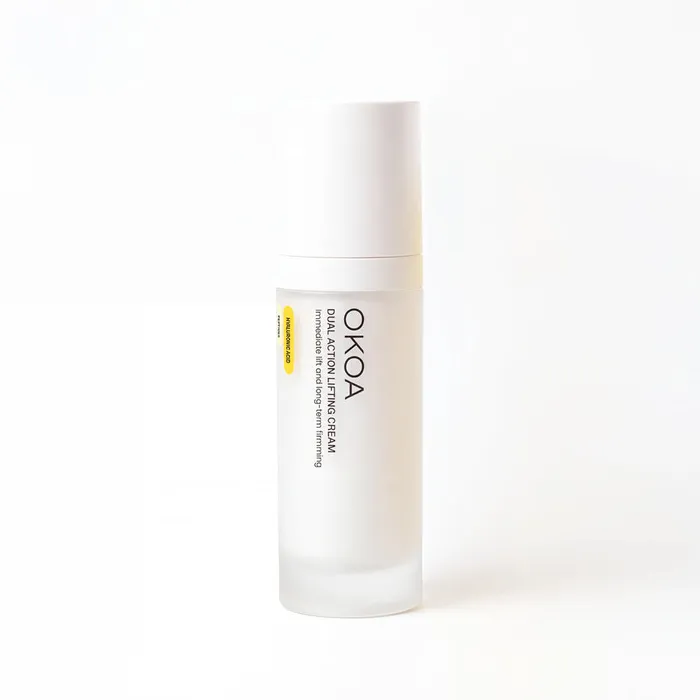
The limit is strength of evidence. Peptides have lighter clinical backing than retinoids for firming, so they are best understood as a gentle, supportive active rather than the strongest one. Peptide-led firming products, such as the OKOA Dual Action Lifting Cream, lean on this appeal: a firming-focused routine without the irritation of a retinoid.
Peptides make the most sense when tolerability matters more than maximum strength, or when retinol is off the table.
Can you use peptides and retinol together?
Yes. Peptides and retinol are complementary, not conflicting. Retinol supplies the strongest firming action, and peptides add a gentle, supportive layer that can help offset some of retinol's harshness.
A common approach is to use a peptide product in the morning and retinol at night. This keeps the two in separate routines, reduces the chance of irritation, and lets each ingredient do its job. If you prefer to layer, apply the lighter peptide serum first, let it absorb, then apply retinol.
Whichever way you split them, introduce retinol slowly and keep sunscreen in the morning routine.
How to choose based on your skin
The simplest way to decide is to match the ingredient to your priority.
- If your goal is the strongest firming result and your skin is resilient, start with retinol.
- If your skin is sensitive or reactive, or retinol has irritated you before, start with peptides.
- If you want a balanced routine that firms while staying gentle, use both on the schedule above.
Neither ingredient is an overnight fix, and neither replaces professional treatments for significant sagging. What they do reliably is support firmer-looking skin over months of consistent use, and daily sunscreen protects that progress.