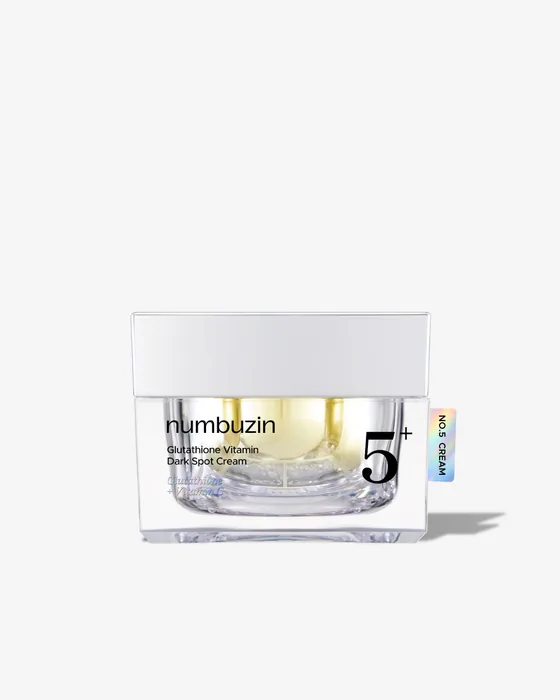
What it does
The body's master antioxidant. Topically supports collagen integrity, brightens uneven pigmentation, and neutralizes free radicals.
Best for
Brightening routines, mature skin, and antioxidant-focused PM use.
What is Glutathione?
Glutathione is a tripeptide, meaning a molecule built from three amino acids (cysteine, glutamate, and glycine). Your cells make it constantly, where it works as one of the body's main antioxidants, mopping up reactive molecules and helping recycle other antioxidants. In skin care it shows up in two chemical forms: GSH, the reduced form, and GSSG, the oxidized form used in at least one notable topical study.
The reason it is marketed for brightening comes down to pigment chemistry. Melanin comes in two broad types: darker eumelanin and lighter, redder phaeomelanin. Lab work suggests glutathione can shift production toward the lighter type and can interfere with tyrosinase, the enzyme that kicks off melanin synthesis. That is a plausible mechanism, which is exactly why the marketing leans on it.
What It Does and Does Not Do
Here is the honest split between mechanism and proof.
What it plausibly does:
- Acts as a genuine antioxidant on skin, which is a real and useful property
- May interfere with tyrosinase, the pigment-triggering enzyme
- May help the look of overall tone and radiance in some short studies
What it does not reliably do:
- It does not cure, erase, or bleach pigment, and it is not a medical whitening treatment
- It does not have strong, large, long-term trials behind the topical brightening claim
- It does not clearly hold results after you stop; effects in the topical trial were temporary
- It struggles to reach the melanosome, the pigment compartment inside cells, which limits how much topical glutathione can realistically do
A frequently cited review put it bluntly, concluding there is little convincing evidence in favor of glutathione for hyperpigmentation at present. The single randomized, double-blind, placebo-controlled topical trial (a 2 percent GSSG lotion over 10 weeks) did show a measurable drop in melanin index, but it was one small study with no follow-up, so the effect looked real but modest and short-lived.
Topical vs Oral vs IV: A Reality Check
The form matters enormously, both for what little evidence exists and for safety.
| Form | Evidence quality | Safety notes |
|---|---|---|
| Topical | Limited: mainly one small RCT plus combination studies; effect temporary | Generally well tolerated on skin |
| Oral | Small, often open-label trials; low bioavailability raises absorption questions | Reasonable tolerability in short studies |
| IV / injectable | Minimal and contradictory; poor study designs | Serious concerns: reports of liver dysfunction, anaphylaxis, and severe skin reactions; not approved for cosmetic lightening in many regions |
The takeaway is that most of the brightening buzz around glutathione actually rides on oral and intravenous studies, not on topical use. And the injectable route, which produces the fastest visible change people talk about, is the one carrying the real safety baggage. Regulators including the US FDA have flagged injectable skin-lightening products as unsafe and unapproved for that purpose. If a clinic offers glutathione IV drips for whitening, that is a medical procedure with documented risks, not a cosmetic shortcut, and it sits well outside what a topical cream can or should try to imitate.
Who It Suits and How to Use It
Topical glutathione suits someone who wants an extra antioxidant in the mix and has realistic expectations, rather than someone chasing dramatic, guaranteed lightening. If you want to try it:
- Apply it to clean skin, typically once or twice daily, and give it consistent weeks, not days
- Pair it with daily sunscreen, since sun exposure drives the pigment you are trying to keep in check and no brightener works against an unprotected face
- Layer it alongside better-evidenced brighteners rather than relying on it alone
- Patch test first if your skin runs sensitive
For the actual heavy lifting on uneven tone, the stronger-evidence options are vitamin C and niacinamide, both of which have deeper research for improving the appearance of dullness and dark spots. Think of glutathione as a supporting player next to those, not the headliner.
Myth vs Realistic Expectations
The popular story is that glutathione whitens skin. The realistic version is narrower. It is a legitimate antioxidant with a plausible pigment-shifting mechanism, but the topical brightening claim rests on thin evidence: a few small, short studies, results that fade, and a molecule that has trouble reaching the exact place pigment is made. The most dramatic before-and-after transformations circulating online usually involve injections, which is a different and riskier category entirely. Set expectations at helps the look of tone over time, keep your sunscreen non-negotiable, and lean on better-studied ingredients for the real work.
Evidence
Topical glutathione has been shown to improve skin brightness, reduce hyperpigmentation, and support antioxidant defense in clinical studies.
Read the source: PMC: glutathione for skin lightening, a regnant myth or evidence-based verity? ->Reviewed August 2, 2026: As of August 2026, the evidence for topical glutathione as a skin brightener remains limited and mixed, and our cautious framing is unchanged.