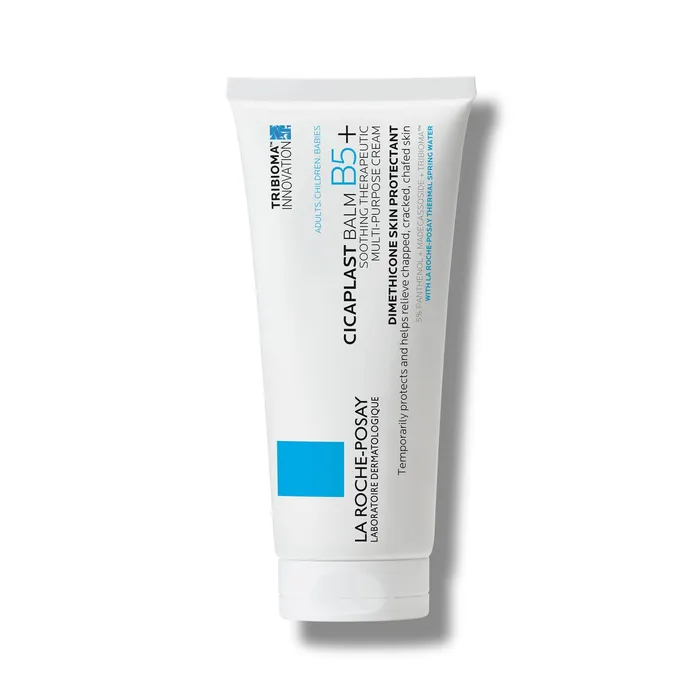
La Roche-Posay Cicaplast Balm B5+ Soothing Therapeutic Multi-Purpose Cream
$32.99 / 3.38 fl oz (100ml)
Key ingredient: Tribioma
Product vs Product
La Roche-Posay Cicaplast Balm B5+ is the pick for a stated 5% panthenol and a lower price, while Avène Cicalfate+ is the pick for a copper and zinc formula whose brand studies publish sample sizes. The US Cicaplast Balm B5+ lists panthenol, madecassoside, zinc gluconate and manganese gluconate, carries dimethicone 1% as an over-the-counter skin protectant active, and lists no copper. Cicalfate+ lists copper sulfate, zinc sulfate and a postbiotic called C+-Restore, with no panthenol, madecassoside or manganese. Avène footnotes its results with studies of 248, 20 and 88 people, while La Roche-Posay publishes no sample size for its 100%, 98% and 85% figures. Both list no fragrance or denatured alcohol, and at US brand-site prices Cicaplast costs $9.76 per ounce versus $11.83 for Cicalfate+.
This summary was generated by AI and reviewed by our editors.
La Roche-Posay Cicaplast Balm B5+ and Avène Cicalfate+ compared on ingredients, brand-reported studies, price per ounce and sensitive-skin facts.
$32.99 / 3.38 fl oz (100ml)
Key ingredient: Tribioma
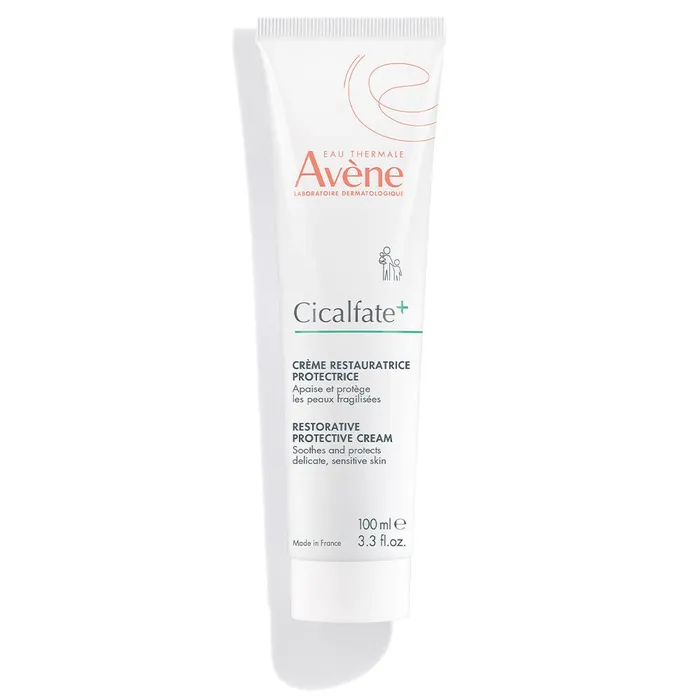
$40.00 / 3.3 fl oz (100ml)
Key ingredient: C+-Restore
| Attribute | La Roche-Posay Cicaplast Balm B5+ Soothing Therapeutic Multi-Purpose Cream | Avene Cicalfate+ Restorative Protective Cream |
|---|---|---|
| Product type | Multi-purpose balm cream for face and body, sold as an OTC skin protectant | Multi-purpose barrier cream for face and body |
| Hero ingredients (stated %) | 5% panthenol, madecassoside (no % given), dimethicone 1% (active) | C+-Restore postbiotic, copper-zinc sulfate complex (no % given) |
| Barrier or biome complex | Tribioma prebiotic complex | C+-Restore postbiotic (Aquaphilus dolomiae ferment filtrate) |
| Minerals listed | Zinc gluconate, manganese gluconate, magnesium sulfate; no copper | Zinc oxide, copper sulfate, zinc sulfate |
| Fragrance and denatured alcohol | Neither listed | Neither listed |
| Texture (brand description) | Rich, non-greasy balm, quickly absorbed | Rich, nourishing cream |
| Size | 3.38 fl oz (100 ml) | 3.3 fl oz (100 ml) |
| Price (US brand site, Sep 17, 2026) | $32.99 | $40.00 |
| Price per ounce | $9.76 | $11.83 |
| Brand study sample sizes | None published for its 100%, 98% and 85% figures | 248 (clinical), 20 (laser study), 88 (self-assessed) |
| Owner | L'Oreal Groupe | Pierre Fabre Laboratories |
| Best for | Dry, irritated skin on a budget, with a disclosed panthenol level | Buyers who want footnoted brand studies or a silicone-free formula |
Pick La Roche-Posay Cicaplast Balm B5+ if you want a stated 5% panthenol, an over-the-counter skin protectant and the lower price. Pick Avène Cicalfate+ if you want a copper and zinc formula whose brand studies publish their sample sizes.
Both are rich, fragrance-free creams sold in 100 ml tubes for face and body, and both brand pages say the product is accepted by the National Eczema Association. Cicaplast Balm B5+ is built around panthenol, madecassoside and dimethicone. Cicalfate+ Restorative Protective Cream is built around Avène Thermal Spring Water, a postbiotic ferment and copper and zinc salts.
We read both US product pages and ingredient lists on September 17, 2026, and did not test either cream on skin. For the wider brand matchup, see our La Roche-Posay vs Avène comparison.
Cicaplast Balm B5+ relies on panthenol, madecassoside and a prebiotic complex, while Cicalfate+ relies on a postbiotic ferment and a copper-zinc sulfate complex. Besides water and glycerin, the two lists share no exact ingredient, though each includes a zinc salt.
La Roche-Posay states 5% panthenol, also called vitamin B5. It lists madecassoside, which the brand says is derived from the Centella asiatica plant, with no percentage. It also names Tribioma, which it calls a proprietary prebiotic complex that helps restore the skin's natural moisture barrier. The US page shows a Drug Facts panel with dimethicone 1% as the active ingredient and "skin protectant" as its purpose.
Avène, a Pierre Fabre Laboratories brand, names C+-Restore, a postbiotic listed as Aquaphilus dolomiae ferment filtrate that the brand describes as rich in proteins. Its copper-zinc sulfate complex appears on the label as copper sulfate and zinc sulfate. Avène gives no percentage for any ingredient.
Two label facts are easy to mix up:
| Cicaplast Balm B5+ | Cicalfate+ | |
|---|---|---|
| First ingredient | Water | Avène Thermal Spring Water |
| Stated percentages | 5% panthenol; dimethicone 1% (active) | None given |
| Signature complex | Tribioma (prebiotic) | C+-Restore (postbiotic) |
| Centella ingredients | Centella asiatica leaf extract, madecassoside | None listed |
| Minerals | Zinc gluconate, manganese gluconate, magnesium sulfate | Zinc oxide, copper sulfate, zinc sulfate |
| Base near the top | Hydrogenated polyisobutene, dimethicone, glycerin, shea butter | Caprylic/capric triglyceride, mineral oil, glycerin, hydrogenated vegetable oil |
| Silicones | Dimethicone, cetyl PEG/PPG-10/1 dimethicone | None listed; Avène states silicone-free |
| Fragrance | None listed | None listed |
| Denatured alcohol | Not listed | Not listed |
| Ingredients on the list | 1 active, 34 inactive | 18 |
On Cicaplast, panthenol sits sixth on the inactive list, right after shea butter. Madecassoside is 15th. On Cicalfate+, caprylic/capric triglyceride, mineral oil and glycerin lead the list, the postbiotic is 11th of 18, copper sulfate 14th and zinc sulfate last.
For the minerals, the study we cite is lab work. A 1999 study in the British Journal of Dermatology exposed cultured skin cells to zinc, copper and manganese gluconate and found that each changed the cells' levels of integrins, surface proteins tied to how the cells move. A cell study does not show that either cream changes how skin looks.
Avène publishes footnotes with sample sizes, and La Roche-Posay's US pages publish percentages without them. Every figure below is brand-reported, not independent testing.
In a clinical study, a dermatologist or technician grades or measures the skin. In a self-assessment, participants score their own skin, which tells you how it felt to them rather than how much it changed.
Avène Cicalfate+
| Brand-reported result | Type | People | Study length |
|---|---|---|---|
| Promotes epidermal restoration from 48 hours | Clinical rating | 248 | 21 days, 2 applications a day |
| Visible improvement in 2 days, p<0.0001 vs untreated skin | Comparative clinical study | 20, aged 18 to 45 | 21 days |
| 80% reduction in skin discomfort after 48 hours | Self-assessment | 88 | 22 days, 2 applications a day |
The 20-person study used forearm skin after an Erbium YAG laser removed its outer layer. Avène's statement about people undergoing cancer treatments cites a poster from the EADO Congress in April 2024, with no sample size on the page. A "4x faster" barrier claim appears only in the page's meta description, with no comparator.
La Roche-Posay Cicaplast Balm B5+
The US landing page shows three figures, each marked with an asterisk: 100% invisible on skin, 98% absorbs quickly, and 85% immediate soothing. No footnote, sample size or study type is published for any of them, and the product page lists no numbered clinical results. The "Recommended by 100,000 dermatologists worldwide" line is a brand-level statement, not a test of this cream.
For dry, irritated skin, Cicaplast Balm B5+ offers a disclosed 5% panthenol and a skin protectant active at a lower price, while Cicalfate+ offers a sized consumer study on skin discomfort.
La Roche-Posay says Cicaplast instantly soothes dry skin irritations and targets 13 daily skin concerns. The page lists it for all skin types and babies 1 week and up, and says it helps treat and prevent diaper rash.
Panthenol has human research behind it. A 2002 randomized study in the Journal of Dermatological Treatment applied a dexpanthenol cream to skin irritated with sodium lauryl sulfate. Compared with the cream base alone, it sped up barrier recovery, raised hydration and reduced redness and roughness. Dexpanthenol is a form of panthenol, and the study used a different cream, so it supports the ingredient rather than Cicaplast itself.
Cicalfate+ has the 88-person self-assessment, in which participants reported 80% less skin discomfort after 48 hours. For the routine side of dryness, our skin barrier guide covers the basics.
Avène Cicalfate+ publishes more detail about post-procedure-style testing than La Roche-Posay Cicaplast Balm B5+, but neither cream stands in for the aftercare plan your provider gives you.
What La Roche-Posay says Cicaplast is for. The US product page calls it suitable for use post-procedure, noting it was tested with a non-ablative laser, with no study size or result. It also calls it suitable for patients undergoing chemotherapy and radiation, with the instruction not to use it on broken skin and to consult a medical professional first. The brand's FAQ says the balm has not been tested to prevent or reduce scarring.
What Avène says Cicalfate+ is for. The page lists sensitive skin prone to visible redness or dryness, minor cuts and scrapes, the perioral area, cracked or chapped skin, the diaper area, skin after sun exposure, and more. Its laser figure comes from forearms, not faces, and its cancer-treatment statement rests on a conference poster.
After a laser treatment, peel or other in-office procedure, use what your provider recommends and ask before switching. A cream can help stressed skin look calmer and feel more comfortable. It does not replace medical aftercare.
La Roche-Posay describes Cicaplast Balm B5+ as a rich, nourishing texture that is non-greasy and quickly absorbed, and calls it a thicker balm. The tube is labeled for adults, children and babies.
Avène describes Cicalfate+ as a rich, nourishing cream, and its packaging says it soothes and protects delicate, sensitive skin. Its 248-person and 88-person studies applied it twice a day.
Both come in tubes for face and body. These descriptions are the brands' own wording, and we did not capture step-by-step directions, so follow the instructions on the tube.
Cicaplast Balm B5+ is cheaper, at $9.76 per ounce versus $11.83 for Cicalfate+.
| Product | Price | Size | Per ounce |
|---|---|---|---|
| La Roche-Posay Cicaplast Balm B5+ | $32.99 | 3.38 fl oz (100 ml) | $9.76 |
| Avène Cicalfate+ Restorative Protective Cream | $40.00 | 3.3 fl oz (100 ml) | $11.83 |
Both tubes hold 100 ml, labeled 3.38 fl oz by La Roche-Posay and 3.3 fl oz by Avène, so the per-ounce math uses 100 ml for both. Avène also sells a 1.3 fl oz tube for $26.00, which costs more per ounce. La Roche-Posay sells a 40 ml size, but we did not capture its price.
Prices come from each brand's US site on September 17, 2026. Avène's site offers 15% off auto-replenishment orders through Subscribe and Save, and retailer sales change both prices.
Neither Cicaplast Balm B5+ nor Cicalfate+ lists fragrance or denatured alcohol, so the choice for sensitive skin comes down to the other ingredients your skin tolerates.
| Cicaplast Balm B5+ | Cicalfate+ | |
|---|---|---|
| Fragrance listed | No | No |
| Fragrance allergens listed | None | None |
| Denatured alcohol | Not listed | Not listed |
| Brand free-from statements | Fragrance free, paraben free, non comedogenic | Fragrance-free, paraben-free, sulfate-free, alcohol-free, silicone-free, non-comedogenic |
| Other ingredients to know | Contains dimethicone, shea butter, phenoxyethanol | Contains mineral oil, beeswax, propylene glycol |
| National Eczema Association | Accepted | Accepted |
| Brand testing and age statements | Dermatologist and pediatrician tested; babies 1 week and up | Safe for infants, children and adults; formulated to minimize risk of allergic reactions |
If you prefer a silicone-free formula, Cicalfate+ is the one labeled that way. If you prefer to skip mineral oil or beeswax, Cicaplast lists neither. Patch-test either cream on a small area first.
Buy this if
La Roche-Posay Cicaplast Balm B5+ Soothing Therapeutic Multi-Purpose Cream
Buy this if
Avene Cicalfate+ Restorative Protective Cream
Prices are MSRP snapshots; confirm on the brand page before buying. These products are researched, not BLC lab-tested, so they are not scored on our 7-criteria system.